LVMH's VivaTech Awards Reveal Three Distinct Tech Bets: Traceability, GEO and Synthetic Training Media
At the 10th VivaTech fair in Paris, LVMH announced three winners across newly separated Innovation Award categories, each reflecting a different tier of the group's current technology agenda. Fairly Made took the Best Impact Award for its supply chain traceability platform, which is now deployed across 14 LVMH maisons including Louis Vuitton, Dior and Celine - a partnership that began four years ago and is now embedded in LVMH's LIFE 360 environmental roadmap. Synthesia received the Best Business Award for its AI video generation platform, which LVMH uses to produce multilingual training materials and product education content across its maisons rapidly and without traditional production costs. The most forward-looking prize went to Bluefish, a US-based startup founded in 2024: its generative engine optimisation (GEO) platform measures and monitors brand visibility within AI-generated answers from tools like ChatGPT, Gemini and Perplexity, and was already working with four LVMH maisons before winning the award.
LVMH chief omnichannel and data officer Gonzague de Pirey framed the Bluefish selection around a commercial shift: a significant number of consumers now go to LLMs first when researching products, making brand representation in AI assistants a strategic priority. Notably, de Pirey and LVMH's group technology director Frank Le Moal were explicit that generative AI within the group remains internal-only, used for training and operations, not customer-facing advertising or media.
 Press Club
Why it matters: The three categories: traceability, synthetic content, and AI discoverability - are not random picks. Together they illustrate LVMH's reading of where fashion technology pressure is actually coming from: regulatory scrutiny of supply chains, the cost of producing content at maison scale, and the erosion of search as the primary discovery channel.
The Bluefish selection is particularly interesting. GEO as a discipline is barely two years old, and the fact that LVMH's chief data officer is already describing LLM visibility as a brand-integrity issue - not a marketing experiment - suggests the group is treating AI assistants as the next surface where luxury positioning can either be protected or lost.
Fairly Made's win is the most commercially mature story: four years of deployment across 14 maisons is a meaningful proof point, and the framing around customer trust and regulatory compliance rather than just ESG optics is a more honest read of why traceability is now a priority for luxury.
The Synthesia prize is the least surprising - synthetic training video is a straightforward cost play - but the group's insistence on keeping generative AI away from customer-facing work is worth noting: it is a deliberate positioning decision, and one that sets a different standard to the many brands currently using AI in advertising without saying so.

Meet Fairly Made at the Fashion Tech Show New York this July!
Zalando Moves Its Virtual Fitting Room From Pilot to Platform
Zalando's in-house size and fit team, an 80-strong group combining machine learning, computer vision and 3D technology, is moving its Virtual Fitting Room from a series of pilots to a permanent, platform-wide experience - with full customer rollout and assortment expansion targeted for this year.
The team, which has been working on the size and fit problem since 2018, operates across three layers: foundational size recommendations drawn from purchase, return and fit feedback data, now covering around 70% of Zalando's assortment; a personalisation layer built on customer size profiles and a body measurement tool that captures measurements from two photos or a short video; and the Virtual Fitting Room itself, which uses those measurements to generate a 3D avatar and show customers how different sizes of the same item would look on their body shape.
More than 1.5 million customers have used the body measurement tool to date. In recent VFR pilots focused on jeans, a category where return rates can reach 65% and a single style can come in more than 30 size combinations, Zalando reported return rate reductions of up to 40%. Across all size and fit interventions, the system prevented 8% of size-related returns in 2025. Fit data is also fed back to brand partners, giving them visibility into where sizing problems recur across categories and body shapes.
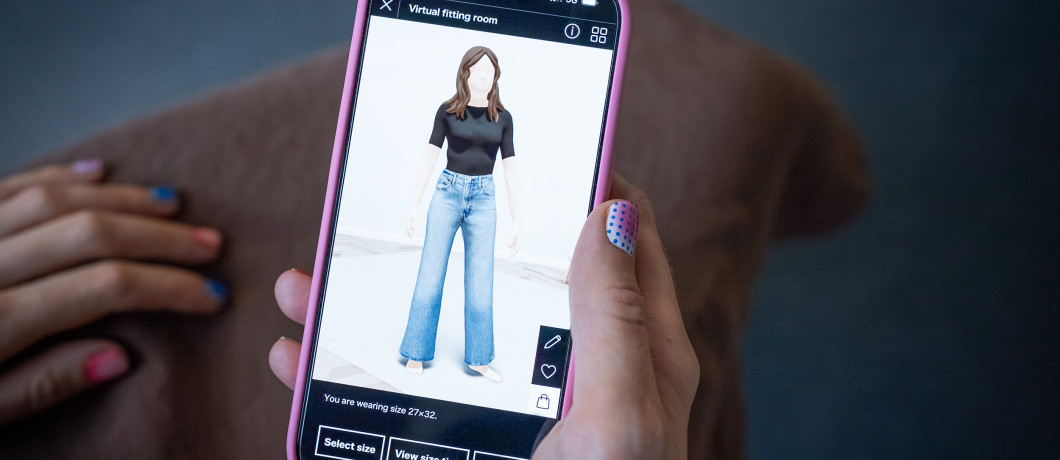
Why it matters: Return rates of up to 50% in European online fashion, with size and fit responsible for half of those, represent one of the industry's most expensive and environmentally costly structural problems, and one that most platforms have addressed only at the surface level. Zalando's approach is notable less for any single tool than for the architecture underneath it: eight years of proprietary data, a body measurement dataset described as the largest anonymised collection from European fashion customers, and a feedback loop that connects consumer behaviour back to brand-level product decisions.
The 40% return reduction in VFR pilots is a self-reported figure from controlled conditions, and what happens when it scales across a full assortment and diverse customer base remains to be seen. But the direction is credible, and the jeans focus is smart - it is the category where the size problem is most acute and where the gap between the fitting room experience and the online experience has always been hardest to close. The broader implication is that fit data, aggregated at Zalando's scale, becomes a structural advantage that smaller platforms and individual brands cannot easily replicate.
Fynd Brings AI Design-to-Fulfilment Platform to the UK
Fynd, the Mumbai-based retail technology company backed by Reliance Retail Ventures and Google, has launched Fynd Create in the UK, positioning it as an end-to-end platform connecting trend intelligence, collection design, sourcing, cataloguing and logistics within a single workflow.
The platform ingests signals from social trends, runway activity and competitor data to surface product opportunities, then allows design teams to generate collections from text prompts before routing those designs into factory matching and production prioritisation. From there, finished products connect to warehousing and distribution, with the intent of removing the data re-entry that typically occurs when design and supply chain systems are separate.
Fynd also includes Fynd Snap, a visual content tool that generates photorealistic on-model imagery from flatlays or 3D renders, allowing brands to build catalogues without a full photoshoot. The company says early deployments showed design productivity gains of up to 60%, though that figure is self-reported without disclosed methodology. Fynd's existing infrastructure spans more than 2,300 brands globally, with a network of over 800 vendors, fabric mills and manufacturing partners available through the platform.
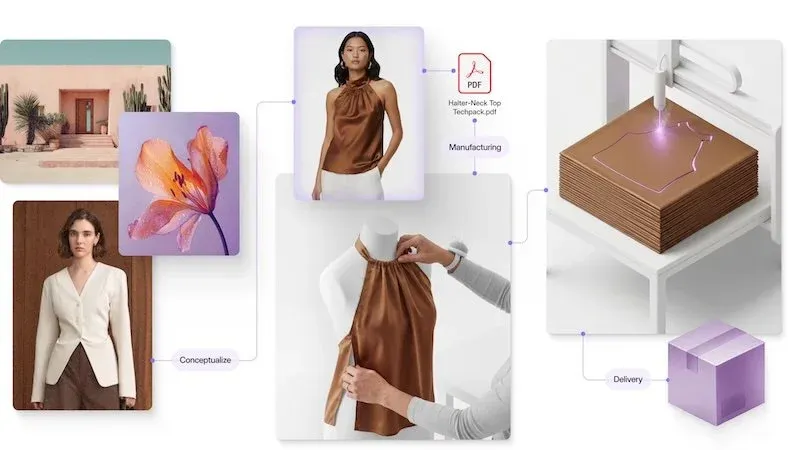
Why it matters: The ambition here is real even if the launch framing is a little oversold. Connecting trend analysis directly to factory allocation and logistics in one system is a genuine structural problem in fashion. Most brands still run these as separate processes, often on separate platforms, with planning teams manually bridging the gaps.
Fynd's existing vendor network is the most interesting part of the pitch: access to 800-plus mills and manufacturing partners is not easily replicated, and for mid-market UK brands without established supply relationships, that sourcing depth could be more valuable than the AI design tooling. The 60% productivity gain should be treated with the usual scepticism - vendor-reported, no methodology disclosed, drawn from markets where design workflows may look very different to a UK brand's.
Adidas and Willy Chavarria Route World Cup Release Through Agentic Storefront
Adidas and designer Willy Chavarria have launched their joint World Cup collection exclusively through Swap Storefront, an AI-driven commerce platform that replaces conventional product pages with a conversational shopping agent. Rather than navigating a standard e-commerce site, customers describe what they're looking for to an AI assistant, which surfaces relevant products, builds outfits on a personalised avatar in real time, and handles checkout within the same interface.
The Chavarria x Adidas drop - inspired by the legacy of the Mexican National Team and the designer's broader exploration of identity and heritage - is the first major fashion exclusive to launch on the platform. Swap, which introduced Storefront in May, claims the format delivers conversion rates twice those of traditional e-commerce and a 20 per cent reduction in returns, though both figures are self-reported and based on a short window of live data.
 Stephen Garner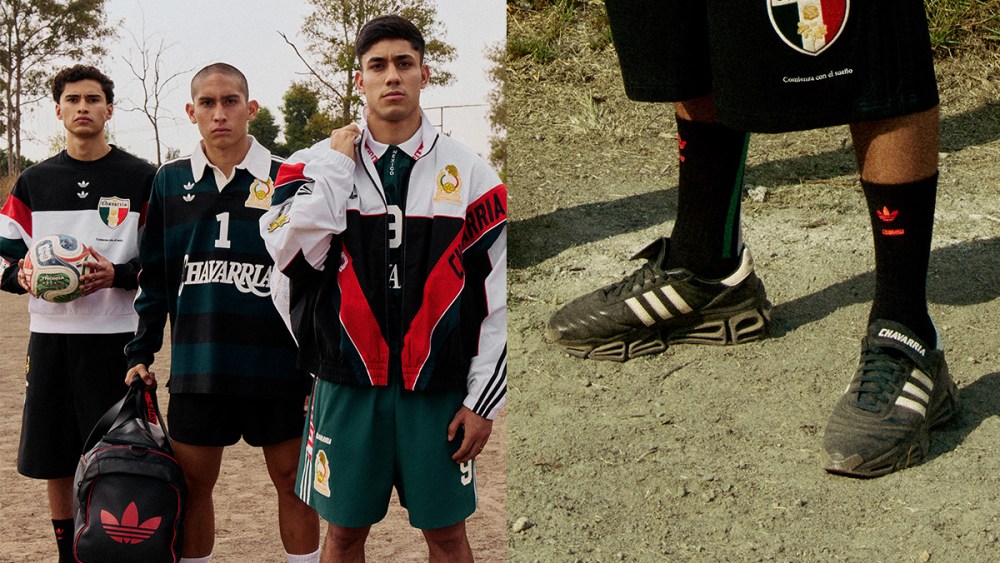
Why it matters: The decision to route an Adidas collab exclusively through a third-party agentic storefront rather than adidas.com or a conventional DTC channel is the genuinely interesting part of this story - less about the collection itself and more about what it signals for how limited releases are distributed. Swap is positioning its platform as the premium-launch layer above standard e-commerce, and landing an Adidas x Chavarria exclusive gives that positioning real credibility.
Avatar-based outfit building at checkout is a meaningful step beyond the static VTO tools most brands are still piloting, and with the World Cup driving one of fashion's biggest moments for football-adjacent drops right now, the timing of this particular exclusive is anything but accidental. Whether the agentic storefront model holds at scale, or whether it remains a novelty suited to hype-driven releases, is the question this launch doesn't yet answer.