


M&S Targets Near 50% Online Share in Fashion, Home and Beauty
Marks & Spencer used its Capital Markets Day on 10 November to set a medium-term goal of close to 50% online participation in Fashion, Home & Beauty, alongside an estate of 180 “highly productive” stores. The retailer wants operating margins above 10% in both channels.
Last financial year the division made a 5.5% margin, and online sales fell 18.4% after the April 2025 cyberattack paused online trading. The recovery since then has been quick. First-half sales in the division rose 17.5% to £1.99bn, with adjusted operating profit of £150.5m. At group level, M&S is guiding to mid-to-high single-digit sales growth, £600m of cost savings by FY28 and a dividend doubled to 8.4p.
 Sophie Smith

Why it matters: The online share target is the easy number. The 10% online margin is the hard one. Returns, delivery and pick costs eat into fashion e-commerce margins, and Retail Gazette reports the division is still dealing with availability problems and higher fulfilment costs.
Reaching double digits online depends on the “factory to floor” supply chain overhaul John Lyttle began last year, because good margins depend on having the right stock in the right place. The 180-store figure works only if those stores handle collections and returns cheaply, which makes the store network part of the online cost base.
 MarketKey Ltd

unspun Moves 3D Weaving Into Arvind’s Ahmedabad Factory
San Francisco’s unspun has partnered with Arvind Limited, one of India’s largest textile-to-retail groups. This puts its OneWeave machines inside a Tier-1 manufacturer for the first time. OneWeave weaves yarn straight into a garment shape, which removes most cutting and much of the sewing. Arvind will install two machines in Ahmedabad, with production due to start by December 2026.
The agreement includes a path to more than 30 further machines across India and/or North America in 2027–28, depending on brand demand. unspun handles installation, operator training, software and servicing, and brands place orders with Arvind directly. unspun is led by former The North Face executive Arne Arens, has raised more than $50m, and counts Walmart and Decathlon as partners.
 unspun
Why it matters: The business model is the real news. Until now unspun has made garments in its own microfactory, which kept volumes small and meant brands had to onboard a startup as a supplier. Routing orders through Arvind lets a brand buy 3D-woven product from a manufacturer already on its approved vendor list, with Arvind’s compliance and capacity behind it. Two machines prove nothing about volume, and the 30-machine path depends on orders arriving. The commercial test is unit cost against conventional cut-and-sew in India. That benchmark is far tougher than the US reshoring case unspun pitched to Walmart and REI in April.
J.Crew Adds Stripe to Widen Payment Options and Prepare for AI Agents
J.Crew Group has added Stripe to its payments stack across J.Crew, Madewell and J.Crew Factory. Ruchika Julapalli, SVP of digital experience, product, technology and AI, said in a LinkedIn post that one Stripe integration now covers alternative payment methods that each used to need a separate build.
The first use was buy now, pay later. Klarna and Affirm went live across all three banners within weeks of each other. Julapalli also said Stripe sets the group up for agentic commerce. Stripe’s Shared Payment Tokens let an AI agent pass a shopper’s payment method to a merchant with spending and expiry limits. Since March they have supported Klarna and Affirm alongside Visa and Mastercard’s agent payment schemes.
 Scott Thompson

Why it matters: J.Crew’s agent readiness is a back-office decision, and a sensible one. There is no chatbot and no ChatGPT storefront. J.Crew has moved its payments onto a provider building the token layer that agent checkout needs, so it can switch agent checkout on once shoppers start using it.
That costs far less than building in-chat experiences that convert poorly, which is what Walmart found when it dropped in-chat checkout. The near-term payoff is BNPL. Running Klarna and Affirm side by side across three banners gives J.Crew a live test of which provider lifts basket size for which customer.
Fanatics Rebuilds Shop the Look With OpenAI
Fanatics has launched an OpenAI-powered version of Shop the Look, which suggests coordinated, in-stock items on product pages. A fan viewing a team jersey sees matching hats, socks and accessories picked by team and style. The models combine product data, team information and live inventory with Fanatics’ own merchandising rules.
The feature runs on Fanatics.com and the official NFL, NBA, MLB and NHL online stores. In testing across about 30,000 MLB products, the new version produced 10% higher engagement than the old one. Fanatics reportedly built the first working version in under a week using OpenAI’s Codex.

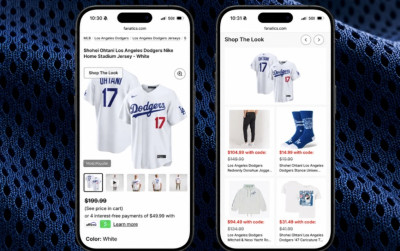
Why it matters: With more than 1.5 million SKUs and licensing rules for every team, Fanatics has no way to curate outfits by hand at this scale. Build speed is the useful detail here. A week from brief to approved product shows how cheap catalogue-level styling has become for any retailer with clean product and inventory data. Engagement is the weakest metric on offer, and Fanatics has not shared conversion or basket size, so the commercial case is still unproven. Like J.Crew, Fanatics is putting AI on its own site and in its own checkout rather than handing the sale to a third-party assistant.