Zalando Backs Sereact to Automate Returns Handling
Zalando has joined the Series B round of Sereact as a strategic investor, taking the round to $116m and the Stuttgart company's total funding beyond $145m. Sereact, founded in 2021 by Ralf Gulde and Marc Tuscher, builds Cortex, an AI control layer that runs across different robot hardware - single-arm picking cells, dual-arm stations, humanoid units - along with Lens, a 3D perception system for inventory and quality control.
The specific draw for Zalando is a dual-arm station that opens a returned parcel, removes the garment, folds it and processes it without human handling. Returns account for roughly half of everything Zalando ships. Sereact has more than 200 systems running across Europe at customers including Mercedes-Benz, Austrian Post and bol., and will put the capital toward Cortex 2.0 and expansion into the US, where it opened a Boston office in June. Masood Choudhry, Zalando's SVP for fulfilment, framed the investment around supporting European technology companies and shaping e-commerce standards.
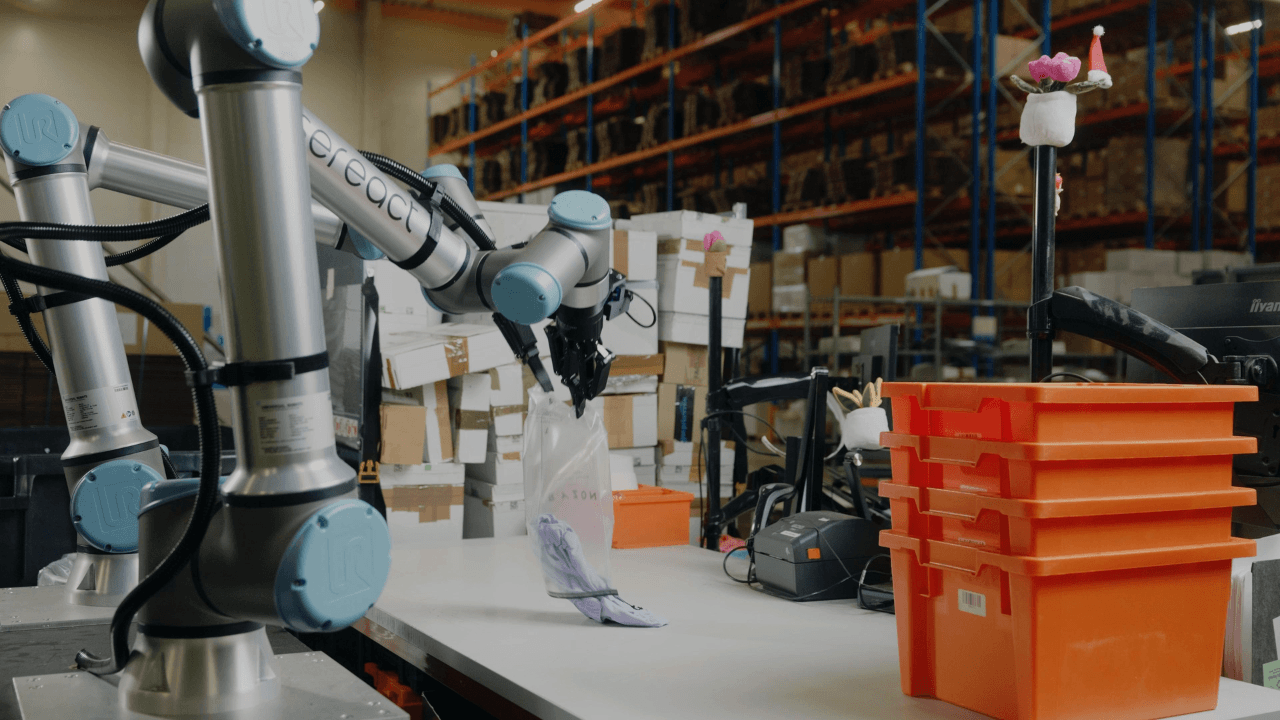
Why it matters: Picking automated years ago because the input is known, the warehouse decides what sits in the tote and how it is presented. Returns have proved far more challenging because the input is whatever the customer put back in the box, crumpled, refolded badly or not at all, sometimes worn. Fixed-program robotics cannot price that uncertainty, which is why the most expensive touchpoint in fashion e-commerce has stayed manual while everything around it got cheaper.
What is worth watching is the structure of the deal rather than the technology claim. Zalando has taken equity rather than signing a supply contract, which presumably buys influence over a roadmap and a position in the queue for capacity that could be scarce if the system works. Retailers do not usually invest in their vendors unless they think the alternative is competing for them.
Shenzhen Team Grows Living Fungal Textile That Repairs Its Own Surface
A team at the Shenzhen Institutes of Advanced Technology, part of the Chinese Academy of Sciences, has published a method for producing flexible textile sheets from fungal mycelium that remain biologically alive after processing, in a paper in Science Advances. The material is grown from Cordyceps militaris, and the advance is in the process rather than the substance: previous mycelium materials were killed during manufacture, producing a brittle sheet, whereas this route preserves cell viability in a freestanding fabric. Because the cells survive, the material retains biological functions. Applying water and fresh fungal pellets to a tear prompts growth across the gap; depositing nutrient droplets in a pattern makes the fungus sprout fibres only where they land, which the team used to grow leaf motifs and the institute's own logo directly into the surface.
Colour and UV protection come from hosting other microorganisms - pigment-producing yeast and melanin-rich fungi - rather than from dyeing or finishing, and a layer of aerial hyphae gives the surface water-repellent and self-cleaning properties. Li Ke, the paper's first author, describes the handfeel as denser and less fibrous than cotton, closer to a soft nonwoven or a flexible leather. The team demonstrated a full-length garment and a set of butterfly wings in blue, and buried a box made from the material in soil, where it broke down almost entirely in 41 days.
 Caroline Lin
Why it matters: Mycelium has been pursued in fashion for a decade largely as a leather substitute - an inert sheet engineered to imitate a material that already exists. What is different here is the ambition: the team treats the fungus as a platform that hosts other organisms and can be patterned, and the demonstrations they chose to publish are aesthetic rather than just technical.
Researchers at the University of Vienna, not involved in the work, made the observation that showing that a living textile is possible is not the same as showing it is preferable to what exists. There is no production route here, no cost figure and no durability data, but nonetheless, it is an interesting insight into where the research frontier has moved.
Phia's Recovery Depends on More Than a Bug Fix
FTW passed on the Phia story when it broke, since the reporting was thorough and the commentary saturated. What almost none of it asked was what recovery would take from a company whose revenue runs entirely through networks that can switch it off. Phia, the price-comparison browser extension co-founded by Phoebe Gates and Sophia Kianni, was suspended from the affiliate network impact.com on 10 July, a day after a Bloomberg investigation found the product claiming referral credit for purchases it had not driven. Testing by Bloomberg, the researcher Ben Edelman and the competing extension Capital One Shopping found that during checkout Phia opened a background tab and injected its own referral code, in some cases overwriting a code already placed by another publisher.
Edelman concluded the extension appeared materially out of compliance with network and merchant agreements. Phia said it had been made aware that a recent release was causing misattributions for a subset of users, that the code dated to December 2025, and that its engineers had resolved the issue overnight; it denied deliberately claiming commissions from competitors' links. Bloomberg retested and found the behaviour had stopped. Awin has opened its own review, impact.com is examining transactions that may have been affected, and no litigation has been filed. The company launched publicly in April 2025 and has raised around $43.5m at a reported $185m valuation.
 Dominic-Madori Davis
Why it matters: Phia is not the first extension to have to talk its way back onto a network. Honey was removed by Rakuten Advertising and suspended by impact.com over comparable findings, then readmitted after shipping a stand-down mechanism that demonstrably defers when another affiliate has already referred the shopper - while the class action against it continues. That is the bar Phia has to clear, and a bug fix is a weaker offer than an architectural change, because a network is being asked to trust a codebase it cannot inspect on the strength of an assurance that the problem was accidental.
The harder question is why this keeps recurring - and the answer is that last-click attribution pays whoever is present at checkout, which is the weakest evidence of influence anywhere in the funnel. Any brand running an affiliate programme is buying a metric that rewards proximity to the transaction rather than contribution to it, and the agentic shopping tools now being built will sit in exactly that position.
EU Digital Product Passport Registry Goes Live Ahead of Textile Rules
The European Commission brought the Digital Product Passport Registry into operation on 20 July, the central database underpinning the passport system established under the Ecodesign for Sustainable Products Regulation. The registry framework was set in place the same month through an implementing act and a decision covering six DPP standards, with a decision on the remaining two due over the summer. The architecture is narrower than the name suggests: the registry stores unique identifiers and mandatory registration data, while the substantive product record sits with the manufacturer or with a DPP service provider, linked to the physical item by a QR code or comparable data carrier.
Once a product is registered, the registry issues a unique registration identifier, which customs can check on imports; goods manufactured inside the EU must be registered before they are placed on the market, and access to the underlying data is governed by user role. Batteries come first, with passports mandatory from 18 February 2027. Delegated acts covering textiles, aluminium and tyres are scheduled for adoption in the third and fourth quarters of 2027, with a separate delegated act governing DPP service providers due in Q2 2027.
 Directorate-General for Internal Market, Industry, Entrepreneurship and SMEs
Why it matters: Fashion has treated the passport as a compliance date that keeps moving, and the dates have obliged by moving! What changed on 20 July is that the technical architecture stopped being hypothetical, and it settles a question brands have been able to defer.
The registry is a pointer system rather than a repository, which means every brand needs somewhere for the actual product record to live and, in most cases, a contract with a certified third-party provider to hold it. That makes this a data infrastructure procurement decision well before it becomes a reporting obligation and the act governing those providers lands two to four quarters ahead of the textile rules themselves. Anyone filing this as a 2028 problem will be selecting a vendor in a seller's market with a deadline behind them!